Most blogs about Salesforce Field Service are written by people who get paid when you buy it. This isn't one of those. We implement Field Service for a living, and the honest answer for most small businesses is "not yet" — and for some, "not ever". The smaller answer is "yes, exactly this, immediately." This post tells you which one you are, with real numbers as of May 2026.
What Salesforce Field Service actually costs
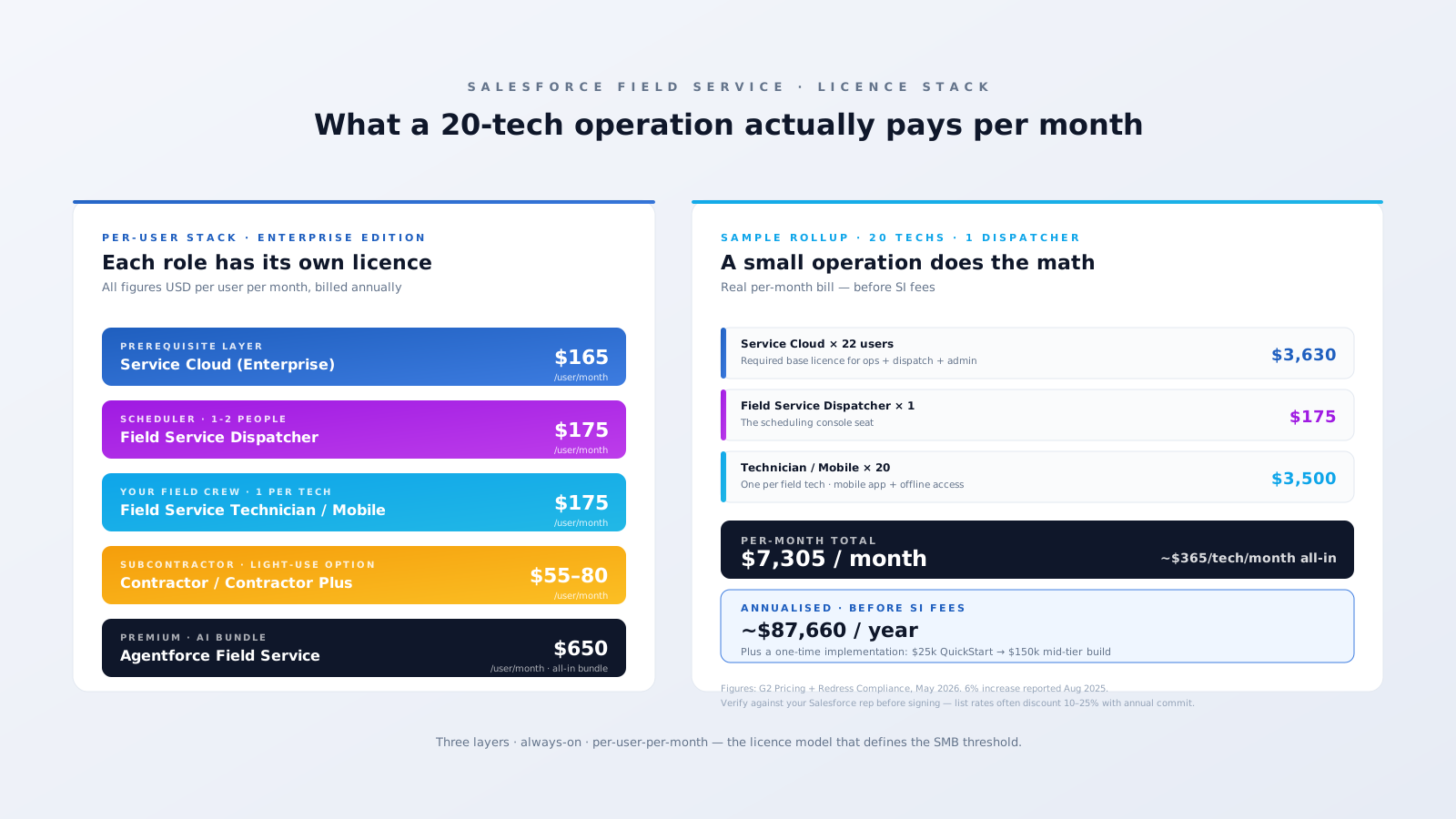
Salesforce Field Service is a layered product. You don't buy "FSL" as a single SKU — you stack a base Service Cloud licence underneath one or more Field Service licences. As of May 2026, the published rates from third-party Salesforce pricing aggregators (G2 and Redress Compliance) put the Enterprise edition at:
- Service Cloud (Enterprise): ~$165/user/month — the prerequisite. Anyone in your org who needs to look at the Field Service data needs a Service Cloud seat first.
- Field Service Dispatcher: ~$175/user/month — the scheduling console seat. You usually need 1–2 of these regardless of operation size.
- Field Service Technician / Mobile: ~$175/user/month — one per field tech. This is the seat that costs you at scale.
- Field Service Contractor: ~$55/user/month (Plus version: ~$80) — for subcontractors or light-use techs.
- Field Service Plus / Unlimited tier: ~$230 to ~$330/user/month for higher feature sets.
- Agentforce Field Service (premium AI bundle): ~$650/user/month — the new bundle that includes AI agents for service.
One quick caveat before anyone signs anything: Salesforce list prices are negotiable. Annual commits routinely come in 10–25% under list, and the August 2025 ~6% price increase reported by licensing advisory commentary means published rates might already lag what your rep quotes. Verify with Salesforce directly before you build a business case on a number from a blog — including this one.

The honest small-business math
Here's the rollup for a representative small operation: 20 field technicians, 1 dispatcher, and a handful of office users (admin, ops manager).
- 22 × Service Cloud Enterprise = $3,630/month
- 1 × Field Service Dispatcher = $175/month
- 20 × Field Service Technician = $3,500/month
- Total: ~$7,305/month · or ~$87,660/year
That works out to about $365 per technician per month in licences alone, before any implementation cost. Implementation for a sub-50-tech operation typically runs from $25k for a tightly-scoped QuickStart through to $75k–$150k for a mid-tier SI engagement, depending on integrations, custom Apex, and how much custom mobile UI you need. Partner hourly rates run $150–$350/hour for certified FSL implementers.
Now compare that to what most small operators run on today:
- Jobber: $69 to $349/month tiered (whole team, not per user)
- Housecall Pro: $49 to $169/month for a small team
- ServiceTitan: ~$250 to $500+/tech/month (not publicly published; estimates from FieldCamp / itQlick)
- FieldEdge: ~$400 to $600/month for a 10-user team (also quote-based)
- RazorSync: ~$85 to $360/month for up to 15 users
For most small operators with under 20 techs, the cheaper SaaS tools are simply better economics. If you're running a residential HVAC company with 8 techs, paying $100/month for Housecall Pro versus $3,000/month for Salesforce isn't a close call.
Where the threshold actually sits
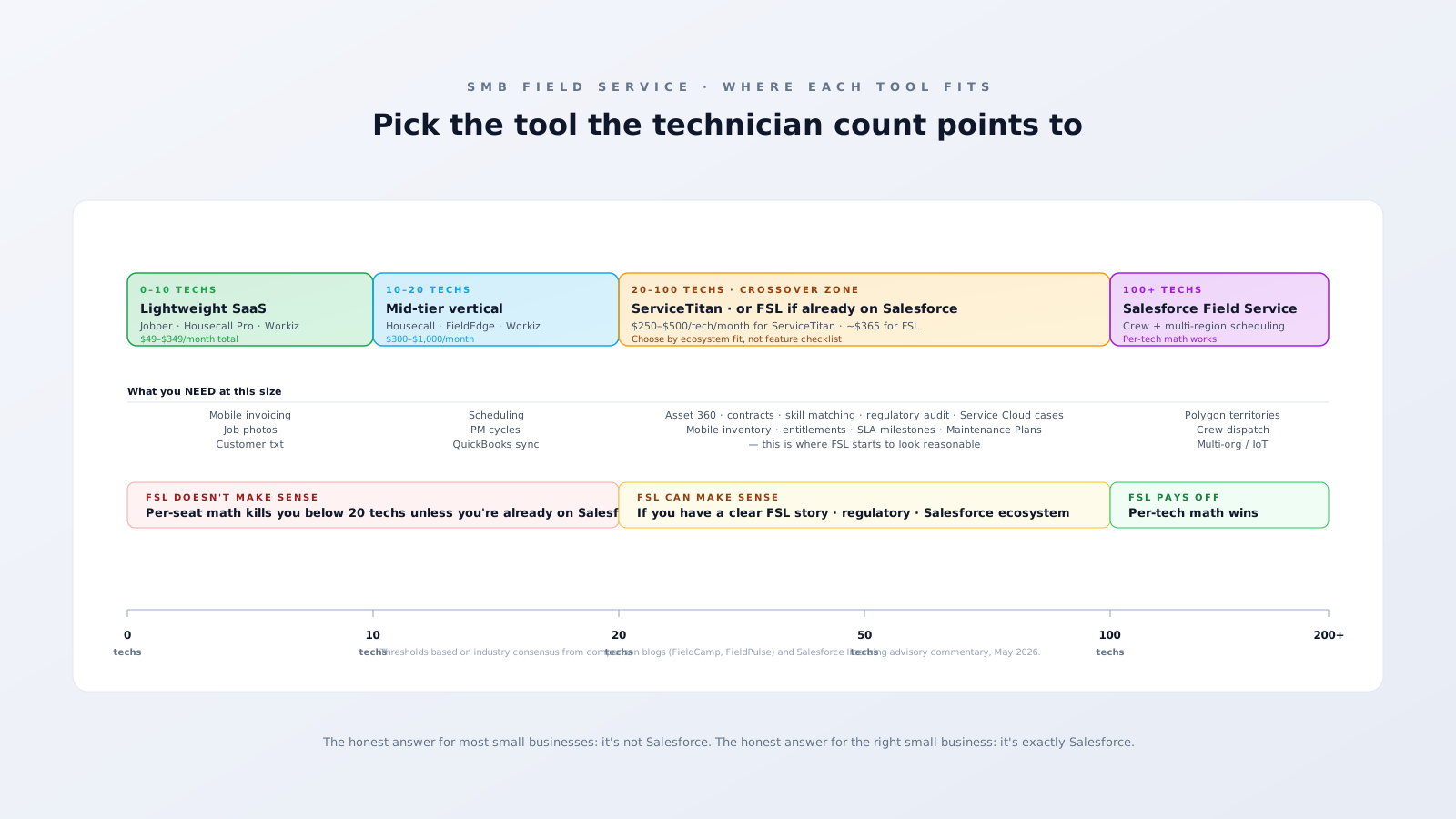
Industry comparison blogs (FieldCamp, FieldPulse, AplosAI) converge on rough thresholds. Salesforce-aligned licensing advisory has been blunt: "any business with fewer than 100 field technicians should start the evaluation elsewhere." That's overstated for the cases below — but as a default heuristic, it's closer to truth than the marketing makes it sound.
When Salesforce Field Service IS right for a small business
FSL becomes a credible call below 100 techs — and sometimes below 20 — when one or more of these are true:
- You're already on Salesforce. If your sales team is on Sales Cloud and your support team is on Service Cloud, adding Field Service piggybacks on the existing licence model and avoids a second platform. The marginal cost is the FSL seats, not the whole stack.
- You service the asset, not the address. If your work revolves around equipment with a serial number, a service history, a warranty window, and a parts catalogue — cranes, medical devices, HVAC rooftops, telco towers, industrial pumps — Asset 360 alone justifies the move from a generic dispatching tool.
- You sell service contracts. Service Contracts driving Entitlements driving Maintenance Plans is a Salesforce native flow. It's how you stop scope leakage, prove SLA compliance, and keep renewal conversations smooth. No SaaS dispatch tool ships this end-to-end.
- You're in a regulated industry. If a missed inspection means a parked machine, an audit finding, or a fine — oil and gas, medical, utilities, heavy equipment — the Salesforce Shield audit trail and skill-expiry tracking pays for itself one regulator visit at a time.
- You're a dealer in an OEM service network. Many OEMs (CAT, Komatsu, Liebherr in heavy equipment; medical device makers in healthcare) push their channel partners onto Salesforce so warranty claims and parts movements unify. If you're inside one of those networks, the choice may already be made.
- You're scaling fast and don't want to migrate twice. If you're 30 techs today and credibly 200 in 24 months, starting on Jobber means a painful migration in 18 months. Starting on Salesforce means seat costs you grow into.
When it's NOT right — and what to use instead
Most small operators should not run Salesforce Field Service. Specifically:
- Under 10 technicians, residential service: Jobber or Housecall Pro. They're built for plumbers, electricians, lawn care, cleaning. They have mobile invoicing, customer SMS, and QuickBooks integration out of the box. Total spend is under $200/month for a team.
- 10 to 20 techs, residential or light commercial: Housecall Pro, FieldEdge, or Workiz. Better vertical fit and cheaper than FSL for this scale.
- 20 to 100 techs, residential trades (HVAC, plumbing, electrical): This is the ServiceTitan zone. ServiceTitan has built deep vertical workflows (memberships, dispatch fees, technician sales tracking, financing integration) that FSL doesn't replicate. If you're a trades contractor in this band and you're not already on Salesforce, ServiceTitan is usually the right answer.
- Generic field labour with no asset story: Cleaning crews, pest control, landscaping. There's no Asset 360 advantage if there's nothing to put in Asset 360.
- You want a fixed-price tool with no integration ambitions: The Salesforce platform is exactly the wrong choice. Use a SaaS tool that updates without your involvement.
Who's actually running Salesforce Field Service in North America and Europe?
This is where I'll be honest in a way most marketing blogs aren't. The publicly-named Salesforce Field Service customers are overwhelmingly enterprise: KONE (elevators, ~60,000 employees), Ferguson (plumbing distribution, $30B+ revenue), large utilities, large telcos, OEM heavy-equipment manufacturers. The big customer-story logos on salesforce.com are not 30-tech operators.
Below the enterprise tier, most SMB Field Service adopters show up in partner case studies as "a North American HVAC contractor" or "a regional medical device service operator" — anonymised because the partners and the customers don't consent to being named. The pattern we see in the field — and what we know from talking to the Salesforce SMB AE community — is that smaller FSL adopters cluster in three sub-verticals:
- Independent OEM service dealers — companies servicing Caterpillar, John Deere, or medical-device fleets who landed on FSL because their OEM partner network mandated it.
- Specialist regulated trades — independent crane, lift, scaffolding, or fire-suppression operators with 20–60 techs whose inspection and certification trail had to live on a regulator-friendly platform.
- "Already on Salesforce" growth companies — fast-growing service businesses (typically 30–100 techs) where Sales and Service Cloud were live, and Field Service was the natural next layer rather than a parallel stack.
If you've seen a small-business FSL customer story you'd like to point at, send it our way and we'll happily write the follow-up. The honest read for now: SMB Field Service is the quieter half of the FSL adopter base — real, but rarely public.
A simple decision framework
Before you call any SI (us included), answer these three questions in writing:
- How many field technicians will be active in 24 months? Under 20 → Salesforce is almost certainly wrong. 20–60 → it depends on the next two answers. 60+ → probably yes.
- Are you already on Salesforce? Yes → the threshold drops by half. No → the threshold doubles, because you're now buying a platform, not adding a layer.
- Do you have a real asset, contract, or compliance story? Yes → FSL's features actually matter. No → a vertical SaaS tool will likely serve you better and cheaper.
If you scored two or more "yes / above the line" on those, the conversation's probably worth having. Otherwise — buy ServiceTitan, Housecall Pro, or Jobber and don't look back. We'd rather tell you that now than after we've quoted a build you shouldn't have started.
Pricing in this post is current as of May 2026 and aggregated from public third-party sources (G2, Redress Compliance, FieldCamp, FieldPulse, itQlick). Salesforce list prices change, and your actual quote will depend on negotiation, commit length, and edition. None of this is a substitute for a real conversation with your Salesforce rep — or with us. Book a 30-minute review if you want to be the one in the room when the math gets done honestly.